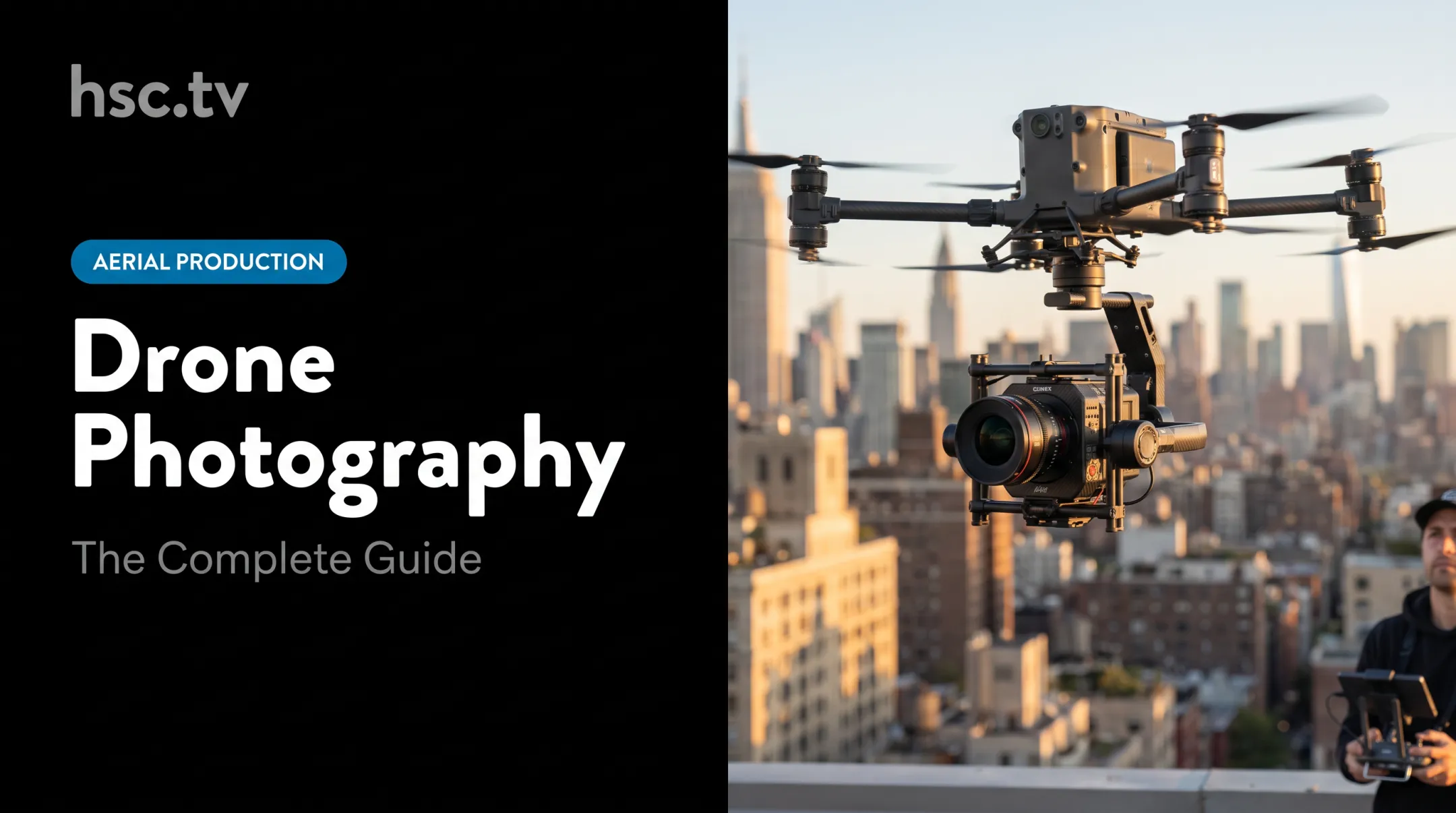

Why does this matter for production teams? Because aerial shots add scale and drama that ground-level cameras simply can't replicate. Fox Sports has used multiple drones, including FPV units capable of hitting 80-99 mph, for its MLB broadcasts since 2015. This piece breaks down the main types of aerial photography, how they differ, and how to pick the right one for your next project.
TL;DR
- Aerial photography spans drones, helicopters, fixed-wing aircraft, and satellites
- Two useful lenses: platform (drone vs. manned aircraft) and angle (oblique vs. vertical)
- Match platform to budget, altitude ceiling, and the level of detail you need
- Choose based on project scale, access constraints, and the final visual you need
- hsc.tv pairs aerial capture with full production and post-production support
What Is Aerial Photography?
Aerial photography is any image or footage captured from an elevated vantage point above the subject. The USGS defines it as imagery acquired by aircraft-mounted cameras, though the modern definition easily extends to drones carrying cinema cameras.
It shows up across a wide range of industries:
- Broadcast and sports coverage
- Real estate and property marketing
- Tourism and destination content
- Documentary filmmaking
Aerial photography is a practical production tool, not just an artistic flourish. Getting it right requires:
- The correct aircraft or drone
- The right camera package
- A pilot who understands the shot list and airspace rules
Why Aerial Photography Matters in Visual Storytelling
Aerial shots give audiences a perspective they simply can't get from the ground. Broadcasters have adopted this aggressively: TV Tech reports that Fox, ESPN, and CBS have all incorporated drones for a more cinematic look, including flying drones close to players during live game coverage.
But aerial work goes wrong fast without proper planning. Common failure points include:
- Poor altitude choices that flatten the shot or violate FAA limits
- Missing permits or airspace authorization, which can shut down a shoot entirely
- Shaky, unstable footage that undercuts the credibility of an otherwise polished production
Match the platform and technique to the story before you book a crew or charter an aircraft. The wrong choice wastes budget; the right one elevates the entire piece.
Types of Aerial Photography
Aerial photography isn't one method. It varies by platform (drone, helicopter, plane) and by camera angle (oblique vs. vertical). Each type addresses a different combination of budget, altitude, coverage area, and required detail.
Drone Aerial Photography
Drone aerial photography uses unmanned aerial vehicles (UAVs) equipped with cameras, remotely piloted from the ground. Drones fly at lower altitudes than manned aircraft, which gives operators close-range, dynamic angle flexibility that's hard to match otherwise. How it differs: Drones win on maneuverability, lower cost, and the ability to fly close to subjects in ways manned aircraft can't safely or legally match. Best suited for:
- Real estate and small commercial shoots
- Branded content and social media campaigns
- Sports coverage requiring dynamic, close-in angles Key strengths: Cost-effective, highly flexible, and capable of unique low-altitude perspectives that would be impossible or prohibitively expensive with a manned aircraft. Limitations: Commercial drone pilots need FAA Part 107 certification. Standard operations are capped at 400 feet above ground level, and drones must stay within visual line of sight. Weather sensitivity and shorter flight range also limit their use on larger productions.

Helicopter and Fixed-Wing Aircraft Aerial Photography
This category covers photography captured from manned aircraft—helicopters or planes—typically flying at higher altitudes than drones are permitted to reach. It requires chartering an aircraft and coordinating shot planning directly with the pilot. How it differs: Higher altitude capability, greater stability at scale, and legal access to airspace drones simply can't touch. Best suited for:
- Large-scale broadcast sports coverage
- Cityscape and landscape documentation
- Major event coverage requiring wide-area tracking Key strengths: Greater altitude range, wider zoom capability, and the ability to cover vast areas quickly. Helicopters can also carry heavier camera payloads and larger crews than drones. Limitations: Higher costs, more logistical planning (aircraft charter, insurance, qualified crew), and more vibration and turbulence to manage in post.

Oblique and Vertical Aerial Photography
This distinction is about camera angle, not platform. It can apply whether you're flying a drone, a helicopter, or a fixed-wing plane.
- Vertical: Camera points straight down at the ground
- Low oblique: Camera is angled; horizon isn't visible
- High oblique: Camera is angled; horizon is visible Best suited for:
- Vertical: mapping, surveying, land-use projects
- Oblique: marketing, storytelling, topographical and archaeological studies Key strengths: Vertical shots offer measurement accuracy useful for maps and site planning. Oblique shots create a natural, immersive perspective that resonates in commercial and broadcast work. Limitations: Vertical shots can look flat and disengaging to a general audience. Oblique shots sacrifice precision, so they're a poor fit for anything requiring accurate measurement. Broadcast production leans heavily on high oblique shots when the goal is drama rather than data. TV Tech describes a stadium exterior shot that tracked between flagpoles before rising to reveal the city skyline, a high-oblique move built for drama, not data.

How to Choose the Right Type of Aerial Photography
The "right" type depends on your project's goals, not on whichever technology feels newest. Weigh these factors:
- Purpose of the shoot — marketing, mapping, storytelling, or live event coverage all call for different setups
- Scale and altitude — a small property shoot needs a drone; a stadium flyover needs an aircraft
- Budget and access — licensed drone pilots are more accessible and affordable than chartered aircraft
- Local regulations — FAA airspace restrictions, LAANC authorization, and TFRs can all affect feasibility
- Post-production needs — aerial footage still needs color grading, editing, and finishing to look broadcast-ready

Raw aerial footage rarely arrives broadcast-ready straight off the card.
hsc.tv folds aerial photography into an integrated production and post-production workflow, so capture, color grading, and final delivery stay under one roof instead of splitting across vendors. For teams on tight broadcast deadlines, that path from concept to final cut cuts coordination overhead that can slow a project down.
Conclusion
Aerial photography now plays a growing role in broadcast, branded, and commercial storytelling. Drones, manned aircraft, oblique angles, and vertical shots each serve distinct creative and technical purposes. None of them is universally "better."
Understanding these differences helps producers and marketers choose not just the right technique, but the right production partner to execute it well.
Frequently Asked Questions
What is aerial view in photography?
Aerial view refers to any image captured from an elevated position above the subject, giving a bird's-eye perspective. It can come from a drone, helicopter, plane, or satellite.
What are the two main types of aerial photographs?
The two primary categories are oblique (angled) and vertical (straight-down) photographs. Oblique suits storytelling and marketing, while vertical suits mapping and surveying.
What equipment is typically used for aerial photography?
Common equipment includes drones, helicopters, and fixed-wing aircraft, with satellites occasionally used for large-scale mapping projects. Choice depends on altitude, budget, and coverage needs.
Do you need a license to fly a drone for aerial photography in the US?
Yes. Commercial drone operators need FAA Part 107 certification, along with compliance with altitude limits (generally 400 feet AGL) and airspace authorization rules.
How much does professional aerial photography cost?
Costs vary based on platform (drone vs. chartered aircraft), project scope, crew needs, and whether post-production services are bundled in. Drone shoots are generally far less expensive than manned aircraft charters.
Can aerial photography be combined with video production services?
Yes. Full-service studios, including hsc.tv, integrate aerial capture into broader production and post-production workflows, so footage moves from shoot day straight into editing and color grading without added handoffs.